
Biens de consommation
Replace manual, siloed processes with integrated, secure, and auditable management.

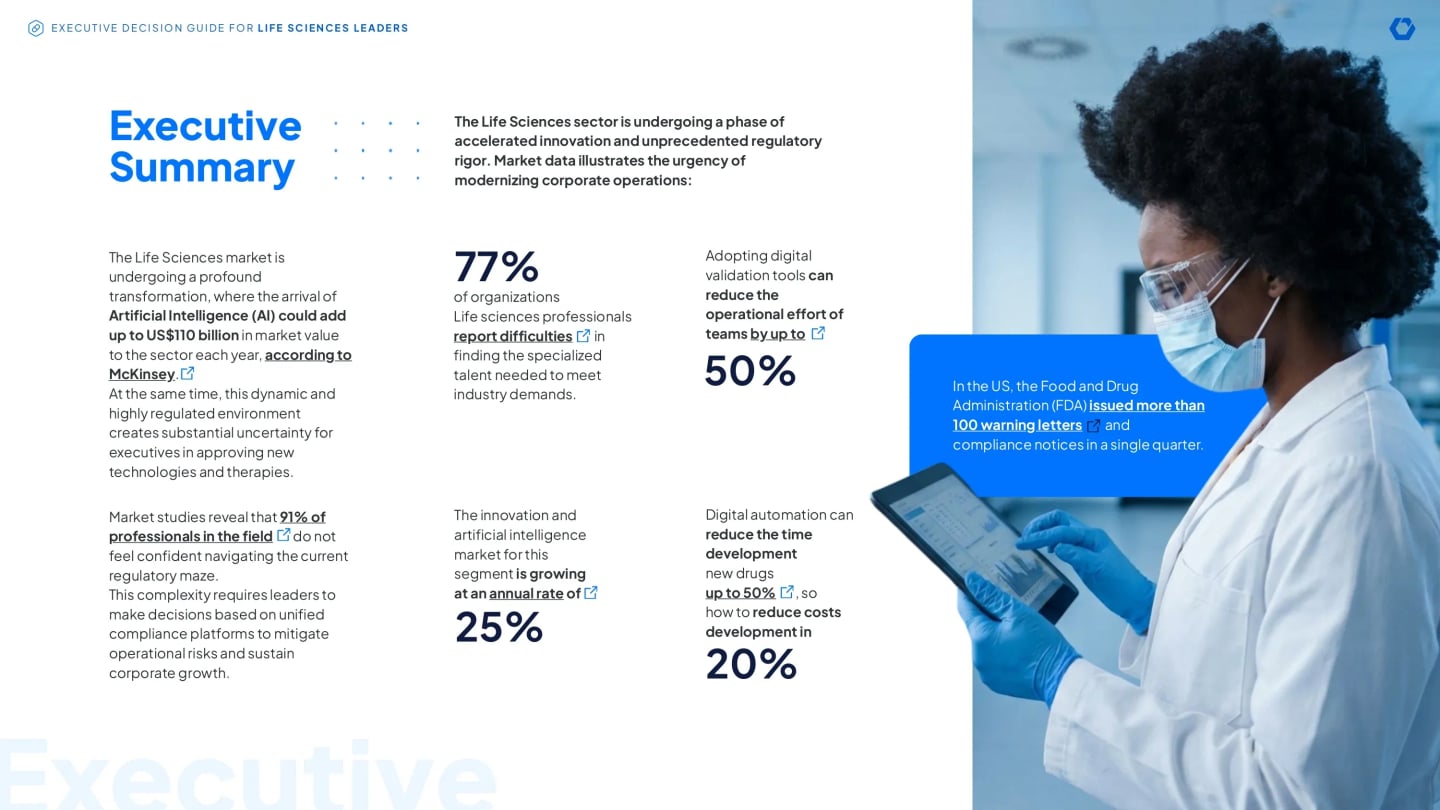
The Life Sciences sector is facing a growing contradiction: the potential for innovation has never been greater, yet regulatory requirements have never been as stringent as they are today. This environment demands an operation capable of moving at the speed the market requires and with the rigor that regulators impose.
This guide delivers the clarity needed for those who must scale operations without paralyzing growth. What you will find inside:
• The global regulatory labyrinth: how to navigate the requirements of international bodies without stalling the pace of research and development (R&D);
• Breaking down barriers in digital validation: practical strategies to adopt automated tools and reduce the operational effort of quality assurance teams by up to 50%;
• Secure Artificial Intelligence: how the arrival of AI can add billions to the sector, provided it is implemented under a rigid model of data control and governance;
• Risk mitigation across the entire chain: pathways to safeguard operations against specialized talent shortages and traceability failures;
• The end of manual spreadsheets: a practical roadmap to unify company data, reducing the high costs of compliance and avoiding human error during audits.
Mastering these trends is the key to breaking down silos between departments and building a management model where innovation and control go hand in hand.









It is a strategic study focused on the primary challenges and trends within the Life Sciences sector, addressing how to unify processes and mitigate risks through integrated compliance platforms, ensuring operational security and sustaining corporate growth.
This guide is designed for directors, managers, and leaders in Quality, Regulatory Affairs, R&D, IT, Risk, and Compliance who operate within the Life Sciences sector and are looking for strategic insights to guide digital transformation decisions.
It offers practical insights to help executives overcome regulatory uncertainty, which affects 91% of professionals in the field, providing a framework to centralize compliance management, lower operational costs, and accelerate time-to-market.
Yes. The guide consolidates quantitative data and projections from major global consultancies, such as McKinsey, contextualizing the real validation and technology challenges faced by industry leadership.
Legacy systems and fragmented processes are disconnected tools that create operational silos. In the Life Sciences sector, this lack of integration drives up compliance costs—which can consume up to 13% of annual operational expenses—consequently increasing exposure to severe audit failures and data security risks.
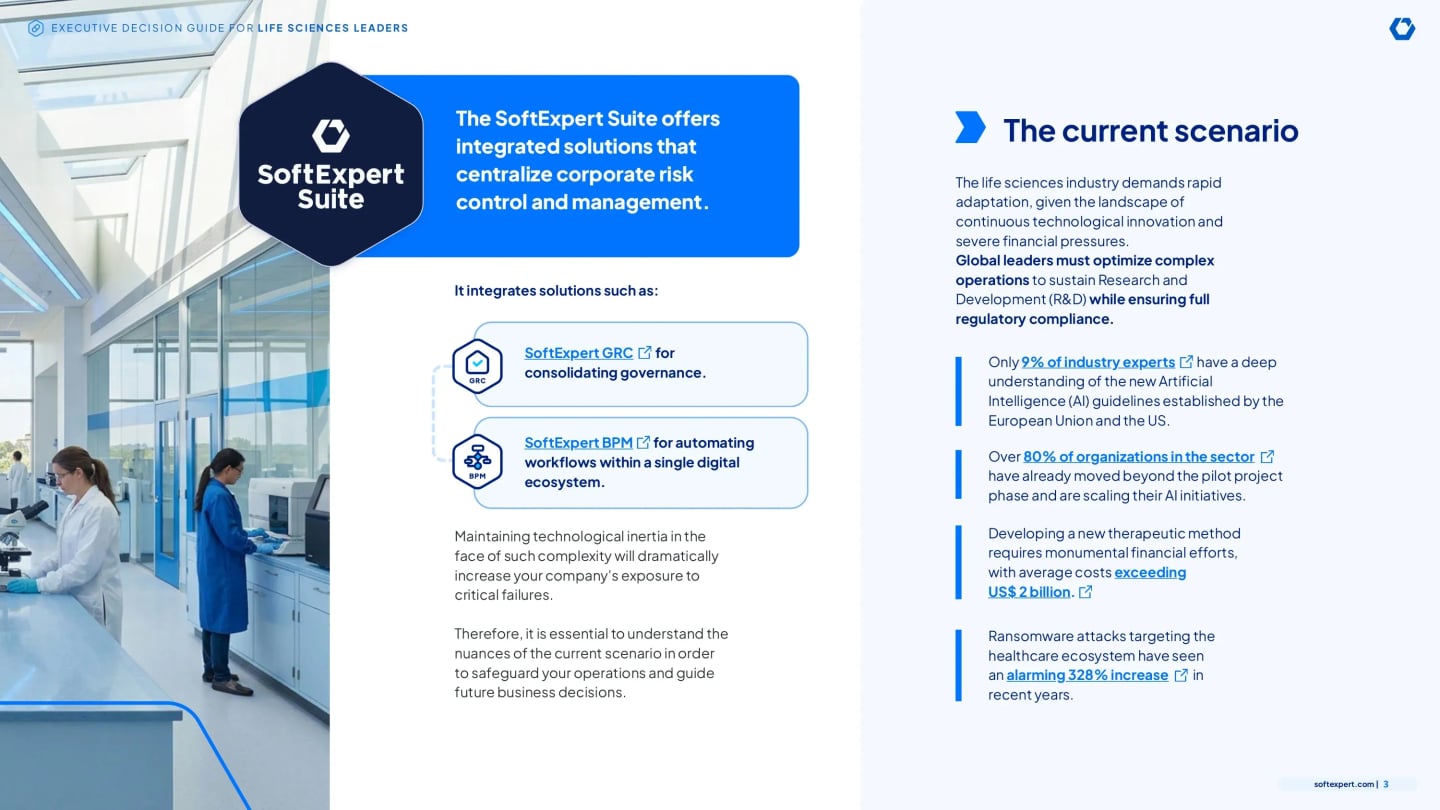
Through the SoftExpert Suite, a unified platform that connects organization-wide silos, eliminating dependency on manual processes and ensuring that compliance, innovation, and risk management operate together in real time.


La présence mondiale de SoftExpert, avec des opérations sur tous les continents, stimule sa croissance en offrant un service solide et personnalisé, adapté à chaque marché local.
Contactez-nous