Governance, Compliance,
and Digital Transformation
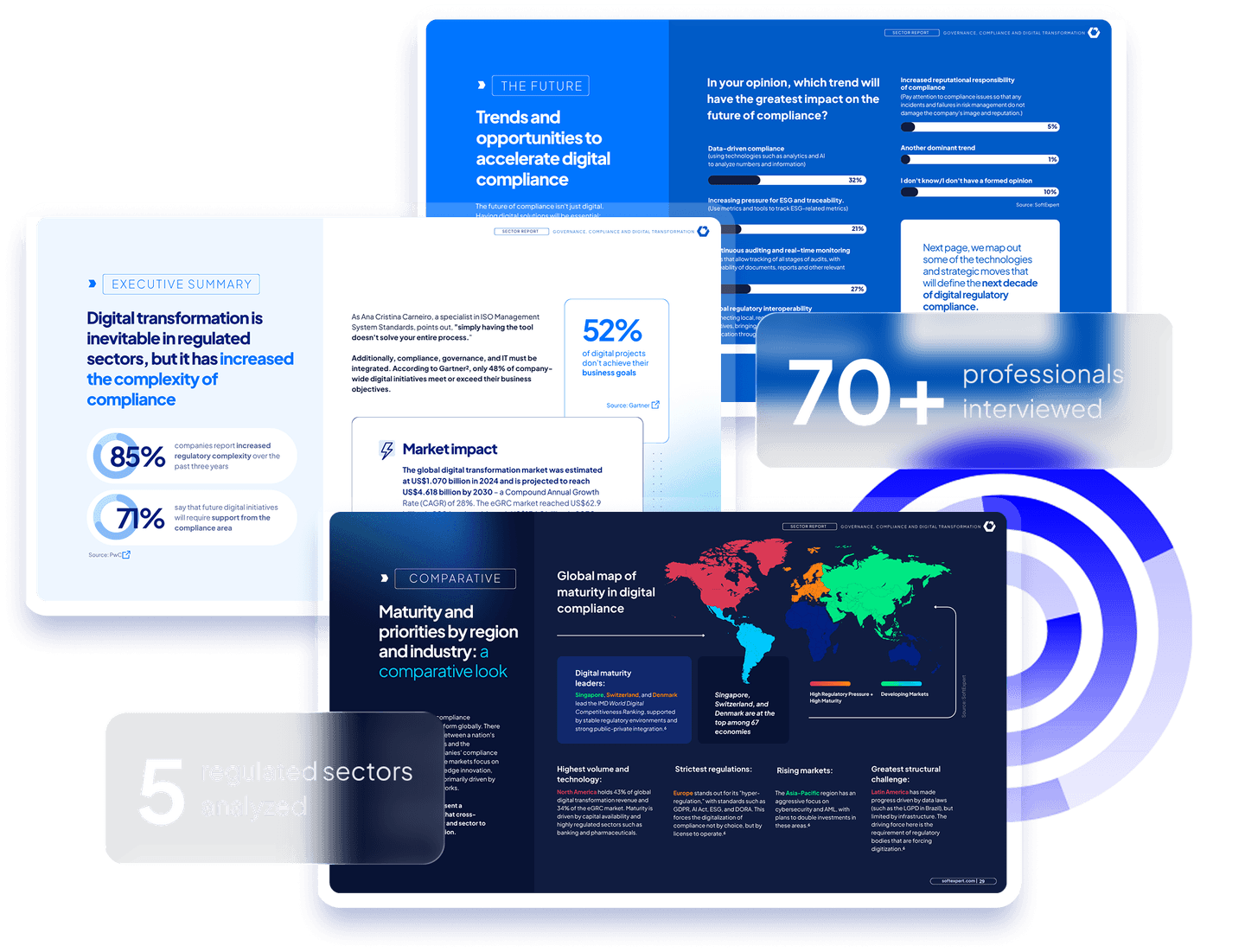
An exclusive study with original data, insights, and interviews with leaders from key regulated markets to support more strategic decisions.
 Exclusive interviews
 Original data
.png&w=32&q=75) 10+ countries
10+ countries.png&w=32&q=75) Free
Free
SUPPORTED BY:




EXECUTIVE SUMMARY
Digital transformation has accelerated.
Compliance has become much more complex
The global digital transformation market was estimated at US$ 1.07 billion in 2024 and is expected to reach US$ 4.62 billion by 2030 (28% CAGR). The eGRC market could more than double over the same period: from US$ 62.9 billion to US$ 134.9 billion.
At the same time, only 48% of digital initiatives achieve their business goals, and the main cause is fragmentation between IT, business, and governance. PwC points out that 49% of organizations already use technology in 11+ compliance activities, led by training (82%), risk assessment (76%), and transaction monitoring (75%).
“Technology is no longer just a support function; it has become part of compliance itself. Automation, intelligent analytics, and workflow tools have made everything more agile and reliable. Today, we can anticipate risks, standardize processes, and act much more strategically.”
Adopting technology ≠ Achieving visibility
49% of organizations use technology in compliance activities, but 64% cite a lack of digital culture and 63% say fragmented data makes compliance more difficult.
Use of emerging technologies and continuous compliance
Integrated systems and implemented automations
Partial use of technology, still with many manual processes
Limited digitization of compliance processes
No defined digital transformation plans
Gains reported by those who have already automated controls (PwC)


Priorities and challenges for each industry
Regulatory pressure manifests differently in each segment. The focus should be where the cost of noncompliance and regulatory complexity are highest.
 Life Sciences
98% of industry leaders say digital tools have improved end-to-end visibility; 62% consider AI highly effective.
Document digitization and CAPA (Corrective and Preventive Actions)
End-to-end traceability
- 75% use technology to automate risk analysis.
- 70% indicate better risk visibility as a core benefit.
Sponsor the full migration of CAPA and validation to integrated platforms — transform GMP/GxP controls from checklists into continuous monitoring.
An 80% reduction in document review management time, with real-time process tracking through Analytics.
Region vs. Industry: a comparative look
There is a direct correlation between a country's digital competitiveness and the robustness of its companies' compliance programs. Singapore, Switzerland, and Denmark lead among 67 economies (IMD World Digital Competitiveness Ranking).
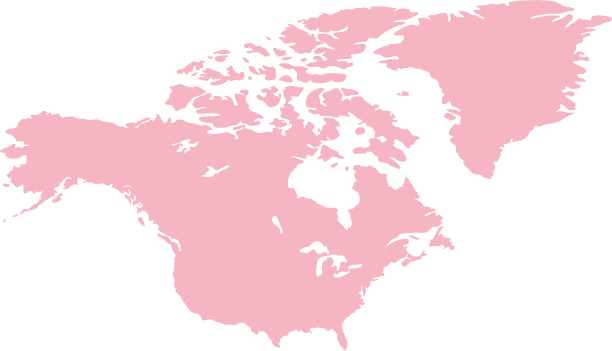
North America
Holds 43% of global digital transformation revenue and 34% of the eGRC market, driven by capital and highly regulated sectors.
Control automation and reduced compliance costs through RegTech.
Supply-chain security: global traceability against geopolitical risks.
AI in clinical trials and agile digital validation.
The 5 levels of digital compliance
Digital transformation must follow an incremental path. Trying to skip steps, such as adopting AI without first having structured data, is a recipe for failure. Success is based on a linear path.
Foundation
 Move away from paper and spreadsheets
- Eliminate Shadow IT
Structuring
- Formalize internal processes
- Begin interoperability between systems
Integration
- Connect GRC, ECM, and ERP with each other
- Ensure traceability across integrated systems
Intelligent Management
- Have predictive analytics and real-time dashboards
- Adopt Continuous Control Monitoring
Autonomous digital compliance
- Run continuous, predictive compliance
- Integrate compliance into the company's operations and strategy
The barriers to standing out in digital compliance
Regardless of industry, organizations run into the same structural barriers: the difficulty of governing data at scale and cultural inertia in the face of change.
Identifying and neutralizing these bottlenecks is the first step to turning compliance from a cost center into a strategic asset.
System and data fragmentation
Multiple non-integrated software tools prevent a "single source of truth," which is critical for audits and decision-making.
63% say data dispersion makes compliance more difficult.
Difficulty integrating data
Without robust data governance, automation only speeds up and automates errors.
43% consider data management critical to compliance.
Low digital culture and internal resistance
Technology can be bought; culture must be built. Success depends on executive sponsorship and change management.
64% cite low digital culture as the main challenge.
Lack of standardization and hyper-regulation
GDPR, LGPD, AI Act, ISO, and FDA create gray areas and require orchestrating local and global requirements in a single environment.
76% of CISOs cite the multiplicity of regulations as a difficulty.
Trends that will define the next decade
The compliance of the future will be predictive, integrated, and autonomous. Organizations that will lead their markets use data governance to anticipate risks and capture value, not just comply with rules.
Data-driven compliance
Analytics and AI to analyze numbers and information
Continuous auditing and real-time monitoring
Traceability of documents, reports, and stages
Growing pressure for ESG and traceability
Metrics and tools linked to ESG
Reputational responsibility of compliance
Protection of the company's image and reputation
“If you cannot measure and visualize your process in real time, you are not managing; you are only reacting to the past.” — Michal Ukropec – CEO
AI revolutionizes compliance
While the market pushes for AI, compliance leaders are taking a more cautious approach to ensure data security. The challenge is not technical; it is one of governance.
What GenAI is already transforming in compliance
“AI is beginning to gain ground by supporting the analysis of large volumes of laws, regulations, standards, and transactions, in addition to contributing to third-party management, fraud prevention and monitoring.”
— Emerson Melo & Tamara R. Oliveira, KPMG
Auditing 100% of the data
GenAI transforms auditing from a random sample into an analysis of the entirety of the data.
Compliance chatbots
Employees ask questions about internal policies in real time.
Automated regulatory analysis
Robots automatically read and interpret global regulatory changes.
Predictive controls
Migration from static rules to models that identify behavioral anomalies (fraud, quality deviations) before they become incidents.
Auditing 100% of the data
GenAI transforms auditing from a random sample into an analysis of the entirety of the data.
Compliance chatbots
Employees ask questions about internal policies in real time.
Automated regulatory analysis
Robots automatically read and interpret global regulatory changes.
Predictive controls
Migration from static rules to models that identify behavioral anomalies (fraud, quality deviations) before they become incidents.
Who is this content for?
C-Levels (CEOs, CIOs, CFOs)
Protect brand reputation, maximize the ROI of digital transformation, and meet the requirements of investors and regulators.
Compliance, Risk, and Quality Leaders
Leave reactive work behind, eliminate manual processes, and turn the area into a strategic business partner.
IT and Innovation Managers
Govern AI and automation, consolidate systems into an all-in-one platform, and eliminate non-integrated legacy systems.
Ideal for anyone working in companies in the following segments:
 Life Sciences
 Financial Services
 Food and Beverage
 Automotive
 Manufacturing
Master the digital compliance landscape
Do not wait for the next audit or a regulatory crisis to discover vulnerabilities in your operation.
Download the full overview and receive the report based on practical evidence.


Everything you need to know
It is an exclusive SoftExpert study that brings together proprietary data, interviews with experts, and market intelligence to analyze the evolution of Governance, Compliance, and Digital Transformation in regulated markets.
