

Biens de consommation
Optimize your validation cycle with a structured framework to ensure Quality and mitigate production risks.
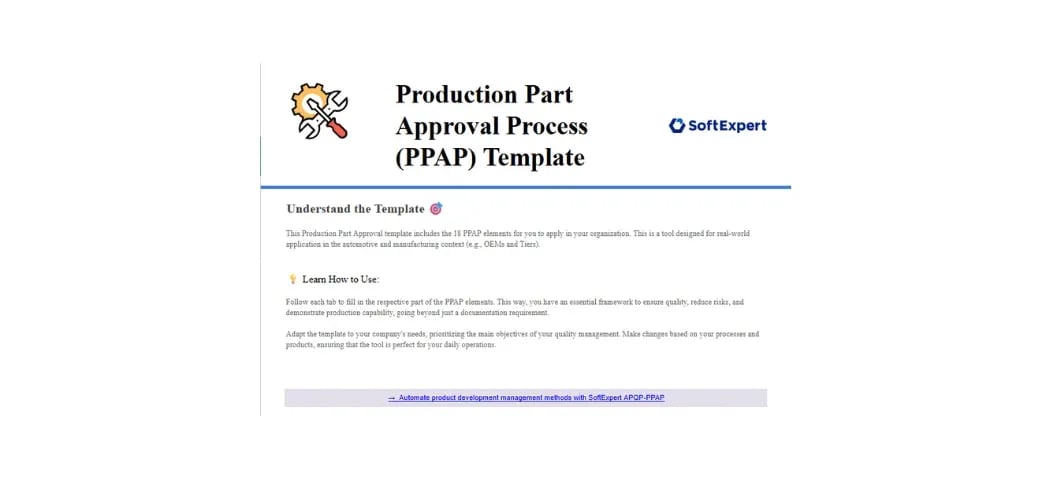
Ensuring that every component meets rigorous Quality requirements before mass production is what defines operational predictability in the automotive and manufacturing industries. Relying on fragmented, manual control methods is often the primary cause of standardization failures and delays in customer part validations.
Here is what you will find in this free PPAP template:
• Comprehensive 18-element framework: Utilize the essential components of PPAP to ensure technical validation and product compliance.
• Reduced rejection rates and rework: Learn how to standardize submissions to prevent documentation errors and accelerate part approvals.
• Integration of critical documentation: Establish the necessary connection between DFMEA, PFMEA, Process Flowcharts, and Control Plans.
• Adherence to global standards: Align your processes with the regulatory requirements of IATF 16949 and VDA.
• Traceability and proof of capability: Replace fragmented controls with a system that demonstrates manufacturing competence through clear, auditable evidence.
Establishing a traceable, unified approval workflow strengthens supply chain confidence, transforming documentation requirements into a demonstration of manufacturing excellence and management maturity.









The checklist covers the 18 fundamental elements of the approval process, including engineering documents such as DFMEA, PFMEA, Process Flow Diagrams, Control Plans, and material test results.
This material provides the necessary structure to meet the part validation and approval requirements mandated by IATF 16949 and VDA manuals, ensuring the organization follows international automotive supply chain standards.
The template includes fields for recording dimensional results, Gage R&R (Measurement Systems Analysis), process capability studies, and compliance records for appearance items.
Eliminating manual controls drastically reduces the likelihood of versioning errors, inconsistencies between documents (such as FMEA and Control Plans), and delays caused by scattered information.
Digitalization enables end-to-end management where approval workflows and revisions are automated. This ensures greater transparency regarding submission status and facilitates readiness for audits by customers and certifying bodies.
Through a unified platform that centralizes all documents and processes within a single system, eliminating dependence on disconnected tools and ensuring full traceability throughout the product lifecycle.


La présence mondiale de SoftExpert, avec des opérations sur tous les continents, stimule sa croissance en offrant un service solide et personnalisé, adapté à chaque marché local.
Contactez-nous