 Infografik
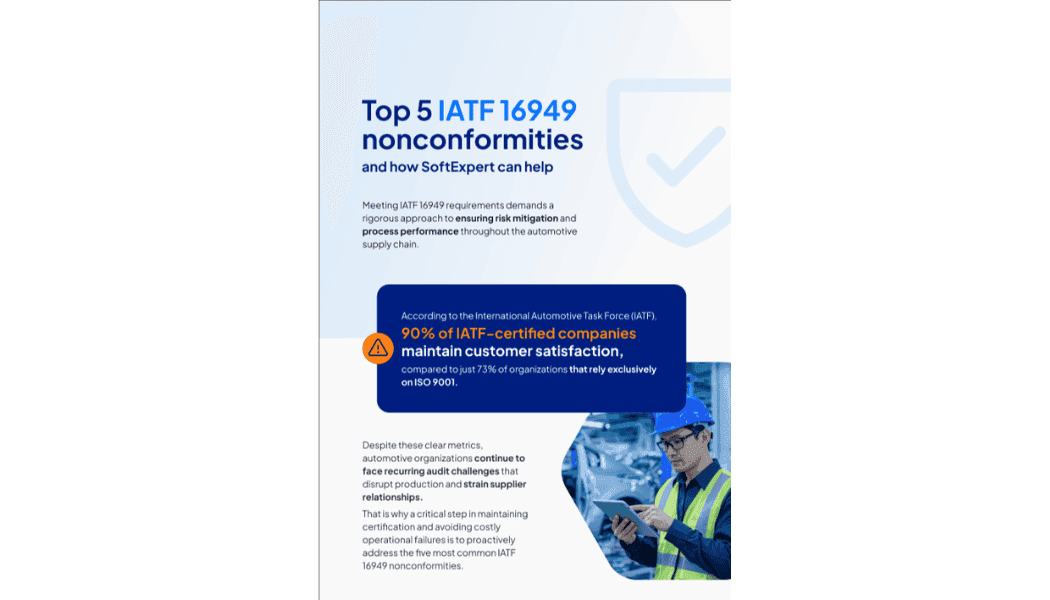
Top 5 IATF 16949 Nonconformities
Discover strategies to implement end-to-end process governance focused on resilience, compliance, and operational efficiency.
Operational excellence goes far beyond isolated actions. It emerges from the alignment between process execution and risk control. For companies pursuing sustainable growth, simply modeling workflows is no longer enough: every stage of the operation must be supported by a governance structure that ensures transparency and agility.
This infographic presents a visual roadmap for transforming complex operations into intelligent workflows, reducing failures and maximizing business outcomes. Explore the pillars covered in this guide:
• Modeling and standardization: how to structure workflows using the BPMN 2.0 standard to ensure operational clarity and repeatability;
• Risk and control management: the importance of integrating risk mitigation directly into process design to anticipate business threats;
• Simulation and optimization: the method for testing scenarios and identifying bottlenecks before execution, preventing financial and human resource waste;
• Real-time monitoring: how to use BAM (Business Activity Monitoring) and Analytics tools to turn data into fast, informed decisions;
• Continuous improvement cycle: the full workflow for analyzing, executing, and auditing processes under a centralized and secure governance layer.
With an operation built on these guidelines, your organization will be ready to establish an integrated governance architecture, where every process directly contributes to business agility and institutional security.
![[EN] Top 5 IATF 16949 nonconformities.png](/_next/image/?url=https%3A%2F%2Fassets.softexpert.com%2FEN_Top_5_IATF_16949_nonconformities_205409cf9d.png&w=1440&q=70)
