CIT
Cas de Succès
"With SoftExpert solution, we won agility, traceability, security, and standardization. Now, we have document control and availability, in addition to conformity with QMS requisites. The system is fundamental for maintaining ISO 9001 certificate. Moreover now, all documentation is audited in the system and the papers were eliminated. "

Valter César de Jesus - CIT Quality Manager
Automated Processes
Reduction of redundant activities
Real-Time Information
Speeding up analysis and actions
Compliance with Requirements
The software integrates all core Quality initiatives
CIT
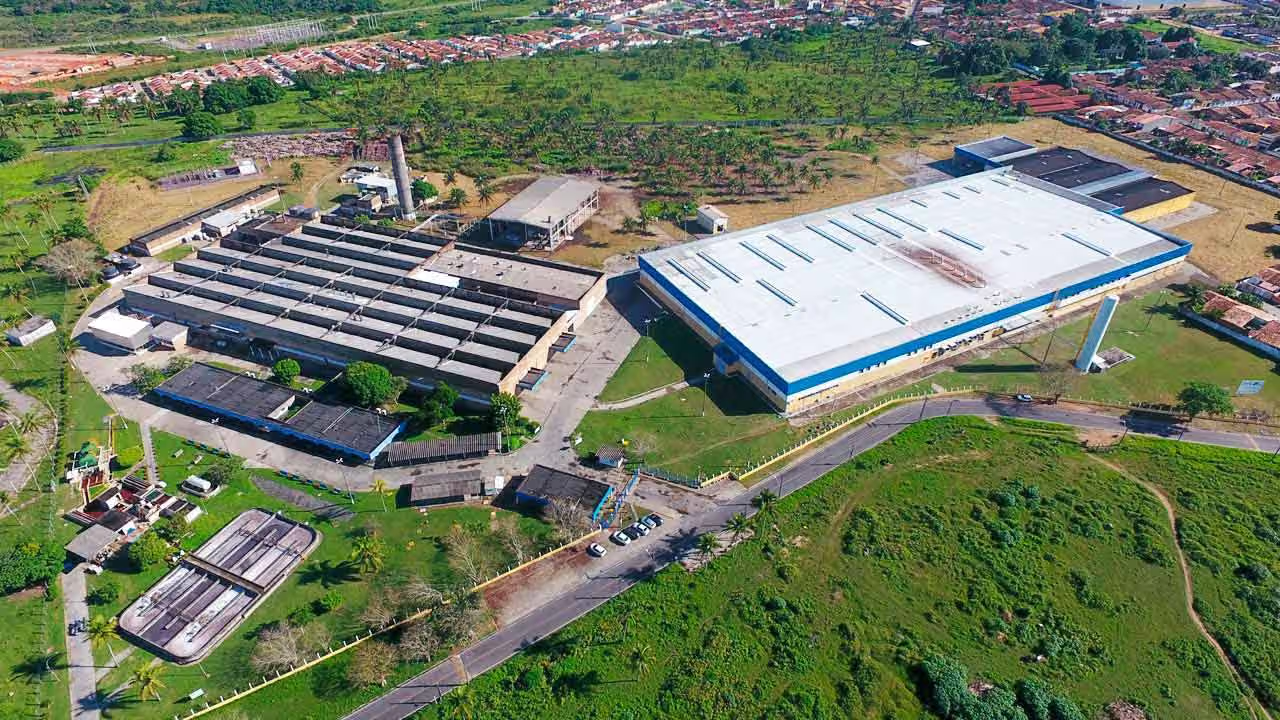
With over 110 years of history, CIT – Companhia Industrial Têxtil specializes in the manufacturing and marketing of twills, denims, and fabrics, providing textile solutions to major companies across Brazil. The company is in constant technological evolution and, in recent years, has invested more than R$100 million to modernize its industrial park, increasing production capacity by 70%. CIT has around 540 employees working at its factory in Estância, Sergipe, and in administrative offices in Aracaju and São Paulo.
- Gestion de la Qualité – QMS
- Brésil
- Biens de consommation
Process improvement
With technologies applied to the production process, CIT also recognized the need to automate its management system across all business units, aiming to optimize processes and enhance customer satisfaction. According to CIT’s Quality Manager, Valter César de Jesus, customer request control used to be managed through spreadsheets. Forms were printed and filled out manually, while alerts about pending issues were sent by email.
“When a customer reported dissatisfaction, for example, at our administrative center in São Paulo, it often took up to ten days for the information—and sometimes even product samples—to reach the factory by interoffice mail. During that time, no action could be taken,” he explains.
Another point highlighted by Valter relates to repetitive tasks. He recalls that when interoffice mail finally arrived at the factory with samples and forms, the information had to be entered again into spreadsheets and electronic files for proper analysis and action. “This resulted in a lot of repetitive work, excessive time to address nonconformities, and delays in providing feedback to customers.”
Pursuit of agility and security
Now, with SoftExpert EQM – the solution for Corporate Quality Management – QMS processes have been fully automated, bringing greater agility and reliability to employees’ daily routines and enabling more efficient, high-quality service for customers.
The software integrates all core quality initiatives, including process mapping, documented information, corrective and preventive actions, and quality indicators. It also supports supplier management, quality inspections, change management, customer complaints, quality audits, training control, skills development, quality risks and controls, as well as statistical process control—enhancing both the agility and robustness of the QMS.
Today, all departments have key users actively working with the tool, which has been essential for maintaining the company’s ISO 9001 certification, held since 2015.
Efficiency in nonconformity management
With automated processes, redundant activities have been eliminated, and the time required to handle non-conformities has been reduced by an average of 50%. Even when samples take a few days to physically arrive at the factory, the technical department can now view the related information in real time within the system, enabling faster analysis and resolution. Valter explains that today there is no need to re-enter data at each stage of the process—once registered, the information is available across all instances, eliminating duplicate work. “An activity that used to take 40 minutes to an hour can now be done with just one click,” he notes.
Another point highlighted by Valter is the ability to access customer documents and records in real time. “Many forms were previously stored in physical files, which took a lot of time to retrieve. Now, within minutes, I can access any record without having to move around or search through documents.”
Looking ahead, the company plans to continue automating process management across other departments to achieve additional certifications, such as ISO 14001, while also enhancing its operations based on ESG (Environmental, Social, and Governance) principles.




Une Vision Mondiale, un Service Local
La présence mondiale de SoftExpert, avec des opérations sur tous les continents, stimule sa croissance en offrant un service solide et personnalisé, adapté à chaque marché local.
Contactez-nous