
Food & Beverage
How to navigate industry complexity and build an operation that responds with agility to global market demands.
The Food & Beverage sector has always been challenging, but the recent combination of financial uncertainty, rising consumer expectations, and regulatory shifts has introduced a level of complexity for which few were truly prepared.
In this landscape, data fragmentation has become a critical risk: without cross-departmental communication, decisions are based on incomplete information, and failures emerge at the most crucial moments. This analysis brings together key industry trends and demonstrates how to build an operation where quality, risk management, and sustainability work in unison.
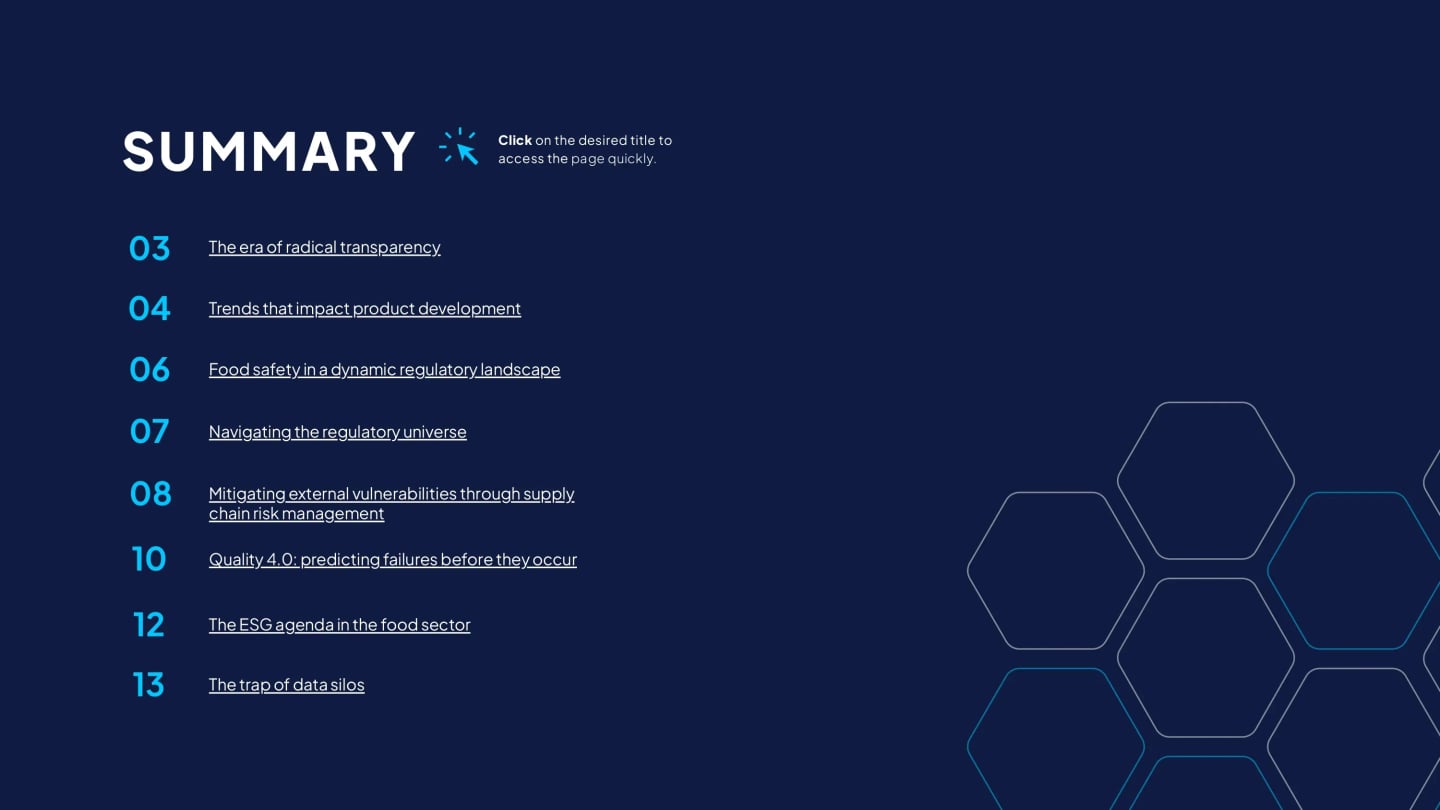
In this material, you will find:
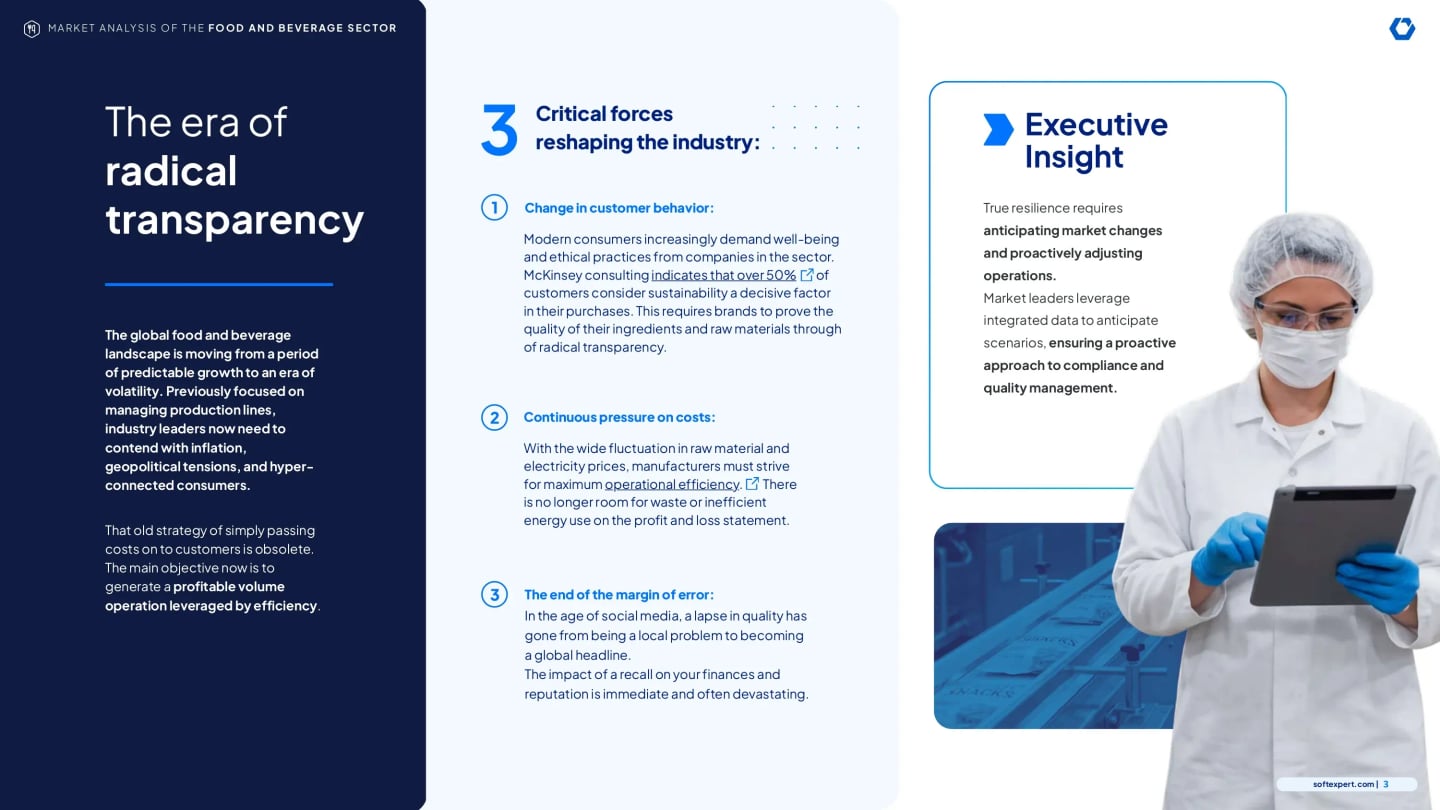
• The era of radical transparency: How shifts in consumer behavior, continuous cost pressures, and the disappearance of the margin for error are reshaping the industry and how to stay prepared;
• Product development in a demanding market: How to structure R&D to balance innovation, traceability, and compliance from the very earliest stages;
• Food safety beyond certification: How to build a proactive quality culture that withstands digital audits and protects your brand in any market;
• Quality 4.0: How to leverage real-time data to predict failures before they occur and convert waste into profitability;
• The ESG agenda in practice: How to integrate environmental data into daily operational workflows to avoid greenwashing, ensure compliance, and transform ESG governance into a pillar of brand value.
Mastering these trends is the first step toward eliminating information silos and establishing a management model where innovation happens with control and the operation gains the predictability necessary for growth.






It is a strategic study focused on the primary challenges and trends within the Food & Beverage sector. It explores how to unify PLM, Risk, and ESG into a cohesive strategy to overcome data fragmentation and ensure food safety, operational efficiency, and regulatory compliance.
This content is designed for executives and leaders in Quality, R&D, Risk, Operations, Sustainability, and Compliance within the Food & Beverage industry who are seeking strategic insights to guide digital transformation decisions.
The material covers six critical areas: accelerated innovation of clean-label and functional foods; traceability by design; product lifecycle management beyond spreadsheets; food safety in a dynamic regulatory environment; Quality 4.0 with predictive failure prevention; and the integration of the ESG agenda into operations.
Yes. The analysis consolidates data and projections from leading consultancies such as McKinsey, Deloitte, and Gartner, alongside data from organizations like Food Chain ID and CDP Worldwide, contextualizing real-world industry challenges with quantitative evidence.
It provides a practical four-phase roadmap: Diagnosis, Standardization, Integration, and Automation. This enables leaders to drive digital maturity in their operations, linking technology to measurable results in food safety, regulatory compliance, and operational efficiency.
Data silos occur when Quality, R&D, and Maintenance systems operate in isolation without communicating with one another. In the food sector, this disconnect leads to labeling errors, specification discrepancies, and recalls—which cost $1.92 billion in the US alone in 2024, according to the Grocery Manufacturers Association (GMA) and the Food Marketing Institute.
Yes. The material features the case of BRF—the company behind brands like Sadia and Perdigão, exporting to 140 countries. BRF utilized SoftExpert Suite to centralize over 1,300 active projects and 30,000 documents, integrating R&D and Quality while eliminating critical data silos.


SoftExpert'in her kıtada faaliyet gösteren küresel varlığı, her yerel pazara özel güçlü ve kişiselleştirilmiş hizmet sunarak büyümesini destekliyor.
Bize Ulaşın